
UNEC Journal of Engineering and Applied Sciences Volume 6, No 1, pages 115-122 (2026) Cite this article,  297 https://doi.org/10.61640/ujeas.2026.0511
To identify the specific features and clarify the mechanism of interaction between free charge carriers and various defects in CdxHg1-xTe crystals, the temperature dependence of electrophysical parameters (specific dark conductivity, Hall constant, and Hall mobility) was experimentally studied in n- and p-type CdxHg1-xTe crystal samples with different Cd contents (with a value of 0.30≤x≤0.80) at weak electric fields. It is shown that in these crystals at T≤120 K, in addition to the scattering of free charge carriers on impurity ions, a significant influence of drift barriers on the process of charge carrier transfer is manifested, and at higher temperatures the influence of scattering on lattice vibrations begins to dominate.
Chalcogenide-based binary and ternary compounds have attracted considerable attention owing to their diverse and multifunctional physical and chemical properties [1–9]. These materials exhibit excellent chemical stability, high crystallographic symmetry, and the ability to accommodate rare-earth ions at relatively high concentrations, making them promising candidates for a wide range of technological applications [9–16]. Depending on their cationic composition and structural arrangement, chalcogenides can be synthesized in highly symmetric polycrystalline and single-crystalline forms, as well as in amorphous glassy states. The versatility of their structural, optical, electrical, and luminescent properties has stimulated extensive research interest and continues to drive the development of advanced functional materials [15–20].
Crystals of CdxHg1-xTe semiconductor solid solutions [21] have long been known to researchers, engineers, technologists, and designers around the world as promising materials for semiconductor physics and solid-state electronics. Although, in connection with the great potential for practical use for the production of various infrared (IR) technology devices, in many cases, the crystals of this semiconductor with a relatively low Cd content (with a value of x≤0.23) mainly attract attention, the information accumulated to date indicates that CdxHg1-xTe crystals with x>0.23, with their unique physical properties, can also be quite suitable and useful materials for studying many interesting issues in the physics of semiconductors [22-27]. In particular, the small value of the effective mass and the high mobility of free current carriers, the possibility of smooth regulation of the Cd content in the solution and, accordingly, the value of the band gap and other characteristic parameters in a wide range, control of the concentration and parameters of defects, as well as surface processes in various ways [28-30] make it possible to study the interaction of charge carriers with defects under various conditions, as well as to identify the features and clarify the mechanisms of various electronic phenomena in this material in particular and in many other semiconductors with similar chemical compositions and crystal structure in general.
Based on the above, in order to identify the features of the electrophysical parameters and clarify the mechanism of interaction of free charge carriers with various defects in CdxHg1-xTe crystals, the features of the specific dark electrical conductivity, Hall coefficient and Hall mobility in samples of n- and p-type conductivity of CdxHg1-xTe crystals with 0.30≤x≤0.80 were experimentally studied at weak electric fields.
The samples were cut using spark erosion from ingots of CdxHg1-xTe single crystals with n- and p-type conductivity, grown using the Bridgman method. Crystals with different conductivity types were obtained by varying the concentration of mercury vacancies. After cutting, grinding with abrasive powders (such as M14, M10, M7, and M5) and polishing with a special diamond polishing paste ensured the desired geometric shape and plane-parallel surfaces. They were then thoroughly rinsed with running bidistilled water and etched.
After washing and etching, the samples were fitted with current contacts made of indium (for n-CdxHg1-xTe) and a special contact alloy (for p-CdxHg1-xTe). The resulting current contacts were ohmic within the experimental measurement conditions, as monitored using a characteristic curve tracer.
The conductivity of the samples studied was determined by the sign of the thermo-e.m.f. and (or) the Hall coefficient.
First, the temperature dependence curves of the dark specific electrical conductivity (σD0) were recorded in samples of both types of CdxHg1-xTe crystals with 0.30≤x≤0.80 (figures 1 and 2).
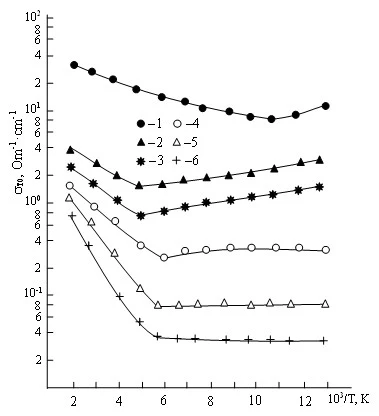
Figure 1. Temperature dependence of specific dark conductivity in n-CdxHg1-xTe crystals with different Cd contents (x values).
x: 1 - 0.30; 2 - 0.40; 3 - 0.45; 4 - 0.55; 5 - 0.65; 6 - 0.80
It was established that, according to the nature of the temperature dependence of σD0, the studied n-type samples (figure 1) are clearly divided into two groups: samples with 0.30≤x≤0.40 (figure 1, curves 1-3) and 0.40<х≤0.80 (figure 1, curves 4-6), respectively. In the first group of samples (figure 1, curves 1-3) in the region of relatively low temperatures (T) with increasing T the value of σD0 decreased somewhat, and in the region of higher temperatures (at T>TM) it increased sharply. With an increase in the Cd content in the solution, the value of the temperature TM at which the course of the curves of the dependence of σD0 on T changes, i.e. both the temperature range and the absolute value of the decrease in σD0 with temperature increase.
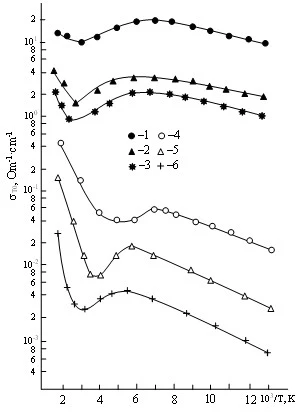
Figure 2. Temperature dependence of specific dark conductivity in p-CdxHg1-xTe crystals with different Cd contents (x values).
x: 1 - 0.30; 2 - 0.40; 3 - 0.45; 4 - 0.55; 5 - 0.65; 6 - 0.80
In the region of relatively high T, the increase in σD0 with increasing temperature has an activation character and the values of the conductivity activation energy determined from the slope of this part of the σD0(T) curves satisfactorily coincide with the value of the band gap of the studied compositions. In CdxHg1-xTe samples with x>0.50 (figure 1, curves 4-6), the value of σD0 is almost independent of T in the region of relatively low temperatures, while at higher T it increases with increasing temperature. Moreover, the values of conductivity activation energy found from the slope of the high-temperature branch of the σD0(T) curves are in satisfactory agreement with the band gap of the studied compounds.
In samples of p-CdxHg1-xTe crystals (figure 2, curves 1-6), regardless of the composition (at 0.30≤x≤0.80), with an increase in temperature, at first (in the region of relatively low T), the value of the dark specific electrical conductivity (σD0), although weakly, still increases, then passing through a maximum, decreases somewhat (2-3 times), and in the region of higher temperatures increases sharply. In this sharply increasing region, the temperature dependence of the specific dark electrical conductivity has an activation character.
In these (p-CdxHg1-xTe) samples, the energy value determined from the slope of the high-temperature branch of the σD0(Т) dependence curves also satisfactorily coincides with the value of the band gap of the studied compositions.
When studying the temperature dependence of the Hall coefficient (RН) (figure 3), it was found that in all the studied CdxHg1-xTe samples, regardless of the composition and type of conductivity (Figure 3, curves 1-6), at relatively low temperatures (T<TM, where TM - is the temperature below which impurity conductivity dominates), the value of RН, and accordingly the concentration of free majority charge carriers (the concentration of free electrons n0 and free holes p0 in n- and p-type crystals, respectively), is almost independent of temperature, and in the region of higher temperatures with an increase in T, it increases.
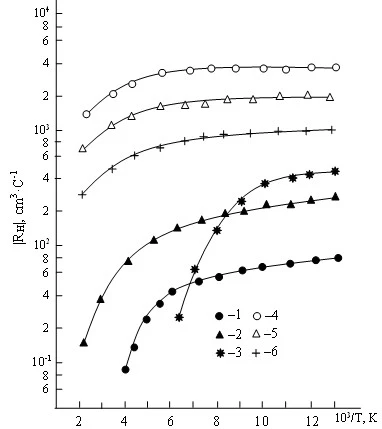
Figure 3. Temperature dependence of the Hall constant in n- (curves 1-3) and p- (curves 4-6) type CdxHg1-xTe crystals with different Cd content (x values).
x: 1, 4 - 0.30; 2, 5 - 0.55; 3, 6 - 0.80
Based on the obtained experimental values of RН and σD0, we estimated the values of the Hall mobility of charge carriers (μН) in the studied samples at different temperatures using the well-known relationship [31] (figure 4).
It was found that in the CdxHg1-xTe crystals studied, the value of μH and its temperature dependence depend on the composition of the samples. In samples with x>0.50, for all considered values of T, with increasing temperature, the value of μH decreases according to the law  . In samples with x≤0.50, with increasing temperature in the region of relatively low T, the value of μH increases according to the law
  and at higher T, it decreases according to the law
  . With an increase in the Cd content in the solution, all other conditions being equal, the value of μH decreases noticeably.
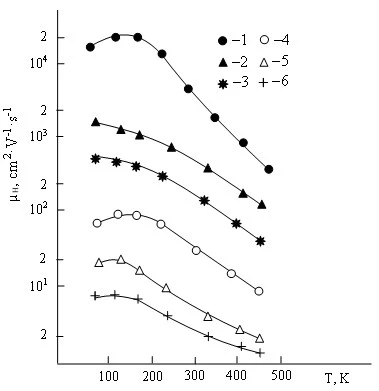
Figure 4. Temperature dependence of the Hall mobility in n-(curves 1-3) and p-(curves 4-6) type CdxHg1-xTe crystals with different Cd content (x values).
x: 1, 4 - 0.30; 2, 5 - 0.55; 3, 6 - 0.80
Proceeding to a discussion of the experimental results obtained, it should be noted that, as follows from the work of some other authors [30, 32, 33], in this semiconductor material, regardless of the degree of improvement of the applied method and growth regime, technological defects exist that significantly affect electronic phenomena, including charge transfer. These technological defects primarily include point defects consisting of mercury vacancies, cadmium, and interstitial tellurium atoms (acceptor type), as well as interstitial cadmium and mercury atoms and tellurium vacancies (donor type). Therefore, significant self-compensation of CdxHg1-xTe crystals is possible under certain conditions. It is also known that the energy position of individual impurity levels relative to the edge of the corresponding allowed bands in this material depends on the composition (Cd content) of the sample being studied. For example, at low Cd contents (at small values of x), the acceptor-type impurity band even lies within the conduction band. With further increase in x, it enters the band gap and gradually moves away from the edge (bottom) of the conduction band. Special doping of CdxHg1-xTe crystals compensates for some of the uncontrolled (technological) levels existing in their band gap. When exposed to penetrating radiation or thermal annealing, the concentration (density) of a particular defect type changes depending on the dose and type of irradiation, the energy of the radiation particles, and the annealing mode. All these circumstances can also significantly affect the features and characteristics of individual physical, including electrophysical parameters of the material.
The possibility of accumulation of point defects in CdxHg1-xTe single crystals in the form of clusters or various inclusions (random macroscopic defects) cannot be ruled out, which can also significantly affect their electronic properties, especially their electrophysical properties [34-36].
A comparative analysis of the temperature dependence of the dark specific electrical conductivity, the Hall constant and the Hall mobility obtained in a joint experimental study in the studied CdxHg1-xTe single crystals of n- and p-type conductivity of different compositions allows us to say that in these crystals, in the region of relatively low temperatures (T≤TM), impurity conductivity dominates. Moreover, at T=77 K, depending on the composition, all impurity levels are either completely (at x<0.50) or partially (at x≥0.50). Therefore, in the region T<TM, the Hall coefficient (and, accordingly, the concentration of free charge carriers) either does not depend on temperature or decreases slightly (the concentration of free charge carriers increases) with increasing T. The barely noticeable increase in RН with increasing T in the region of relatively low temperatures found in some samples can be explained by the compensation of the crystal being studied [37]. In this case, like what was proposed in [38], it can be assumed that with increasing sample temperature, free charge carriers are recaptured by compensating levels through thermal pumping through the corresponding zones. At the same time, like what was proposed in [19], in some samples in the region of relatively low temperatures, the change in the value of RН (and, accordingly, the concentration of free charge carriers) can be explained by the partial spatial inhomogeneity of the sample under study.
The weak temperature dependence of the specific dark electrical conductivity observed in the region of relatively low temperatures (where the value of RН does not depend on T) can be explained by the temperature dependence of the mobility of free charge carriers. It should be noted that this dependence μН(Т) occurs both because of carrier scattering on various point defects and lattice vibrations [31], and because of a decrease in the influence of drift barriers for current [39] created due to the presence of random macroscopic defects on the process of charge carrier transport.
It should be noted that the main signs of the manifestation of one or another mechanism of change in the mobility of free charge carriers is the specific course of its temperature dependence. In the case of scattering of free charge carriers on various point defects and lattice vibrations, the dependence of their mobility on temperature obeys power laws (the only exception is the case when scattering on polar optical phonons dominates) [31], and in the case of a change in the influence of drift barriers for current, the temperature dependence of the mobility of charge carriers should have an activation character [39].
A comparative analysis of the curves of the σD0(Т), RН(Т), μН(Т) dependencies allows us to say that the decrease in the σD0 value with increasing T, detected in n-CdxHg1-xTe samples with 0.30≤х<0.40 in the low temperature region, is associated with the scattering of free charge carriers on acoustic vibrations of the lattice. As for the growth of σD0 with increasing temperature in samples with x≥0.40 in the region T≤120 K, it is apparently due to the dominance of the scattering of free charge carriers on impurity ions [31].
In the region of relatively high temperatures (at T>TM), intrinsic conductivity dominates. With increasing temperature, both the concentration of free charge carriers (correspondingly, the value of RH decreases) and the electrical conductivity (σD0) increase sharply (exponentially). In this temperature range, the rate of temperature dependence of n0 on temperature significantly exceeds the rate of temperature dependence of μH. Therefore, the μH(T) dependence does not appear on the curves of σD0 versus T.
The negative value of RН in the studied n-CdxHg1-xTe crystals at all the temperatures considered indicates that in these samples, under the conditions of the experimental studies, the value of σD0 is always determined by electrons (the main charge carriers).
The observed behavior of the μH temperature dependence curves indicates that in both n- and p-type CdxHg1-xTe crystals, at higher temperatures, the dominant mechanism for free charge carrier scattering is scattered by acoustic lattice vibrations. Depending on the value of x (the Cd content in the solution), the dominance of this mechanism decreases at the lower limit of the temperature range, and in some cases even reaches 77 K.
In the temperature range T≤120, a decrease in σD0 with increasing T in n-CdxHg1-xTe crystals with 0.30≤х<0.40 is associated with the scattering of free charge carriers on acoustic vibrations of the lattice, and an increase in σD0 with increasing temperature in samples with х≥0.40 is due to the dominance of scattering of free charge carriers on impurity ions; At relatively high temperatures (T>TM), intrinsic conductivity dominates in n-CdxHg1-xTe crystals, and the rate of temperature dependence of n0 significantly exceeds that of μH. Therefore, the μH(T) dependence does not manifest itself in the curves of σD0 versus T. In n-CdxHg1-xTe crystals, at all the temperatures and conditions of the experimental studies considered, the value of σD0 is determined by the majority charge carriers. In both n- and p-type CdxHg1-xTe crystals, at higher temperatures, the dominant scattering mechanism for free charge carriers is scattered by acoustic lattice vibrations. Depending on the value of x (the Cd content in the solution), the dominance of this mechanism decreases at the lower limit of the temperature range, and in some cases even reaches 77 K. In the region of relatively low temperatures (where the value of RН does not depend on T), the weak dependence of σD0 on T is caused only by the dependence of μН(Т), which occurs both as a result of the scattering of carriers on various point defects and lattice vibrations, and as a result of the reduction in the influence of drift barriers for current created due to the presence of random macroscopic defects on the process of charge carrier transport.
1 A.S. Abdinov, R.F. Babaeva, R.M. Rzaev, Inorganic Materials 48(8) (2012) 781. https://doi.org/10.1134/S0020168512080018
2 S.G. Asadullayeva, Z.А. Jahangirli, T.G. Naghiyev, A.S. Abiyev, Current Applied Physics 76 (2025) 39. https://doi.org/10.1016/j.cap.2025.05.007
3 A.P. Abdullayev, R.M. Rzayev, T.G. Naghiyev, J.P. Mammadova, S.S. Aliyev, I.V. Musazade, International Journal of Modern Physics B 37(28) (2023) 2350248. https://doi.org/10.1142/S021797922350248X
4 A.S. Alekperov, A.O. Dashdemirov, T.G. Naghiyev, S.H. Jabarov. Semiconductors 55 (2021) 574. https://doi.org/10.1134/S1063782621070034
5 S.G. Asadullayeva, Sh.Sh. Amirov, UNEC J. Eng. Appl. Sci. 5(2) (2025) 104. https://doi.org/10.61640/ujeas.2025.1209
6 T.M. Ilyasly, R.F. Abbasova, S.M. Veysova, G.H. Gahramanova, A.Y. Suleymanova, M.A. Huseynov, UNEC J. Eng. Appl. Sci. 5(2) (2025) 127. https://doi.org/10.61640/ujeas.2025.1212
7 T.G. Naghiyev, R.M. Rzayev, Modern Physics Letters B 35(31) (2021) 2150469. https://doi.org/10.1142/S0217984921504698
8 M.S. Leanenya, E.V. Lutsenko, V.N. Pavlovskii, G.P. Yablonskii, T.G. Nagiev, B.G. Tagiev, O.B. Tagiev, S.A. Abushev, Journal of Applied Spectroscopy 82 (2015) 53. https://doi.org/10.1007/s10812-015-0063-6
9 A.I. Isayev, S.I. Mekhtiyeva, H.I. Mammadova, R.I. Alekberov, Q.M. Ahmadov, N.N. Eminova, A.Ch. Mammadova, L.A. Aliyeva, L.V. Afandiyeva, R.F. Sadikhli, UNEC J. Eng. Appl. Sci. 4(1) (2024) 55. https://doi.org/10.61640/ujeas.2024.0505
10 I.I. Aliyev, Kh.M. Gashimov, C.A. Ahmedova, UNEC J. Eng. Appl. Sci 2(1) (2022) 45.
11 T.G. Naghiyev, U.R. Rzayev, E.M. Huseynov, I.T. Huseynov, S.H. Jabarov, UNEC J. Eng. Appl. Sci 2(1) (2022) 85.
12 A.Sh. Abdinov, R.F. Babayeva, N.M. Gasanly, T.G. Naghiyev, International Journal of Modern Physics B (2026) https://doi.org/10.1142/S0217979226501870
13 A.Sh. Abdinov, R.F. Babayeva, S.I. Amirova, N.A. Rahimova, E.A. Rasulov, UNEC J. Eng. Appl. Sci. 5(1) (2025) 55. https://doi.org/10.61640/ujeas.2025.0506
14 R.I. Alekberov, A.I. Isayev, S.I. Mekhtiyeva, Margit Fabián, UNEC J. Eng. Appl. Sci. 1(1) (2021) 27.
15 B.G. Tagiyev, O.B. Tagiyev, A.I. Mammadov, Vu Xuan Quang, T.G. Naghiyev, S.H. Jabarov, M.S. Leonenya, G.P. Yablonskii, N.T. Dang, Physica B: Condensed Matter 478 (2015) 58. https://doi.org/10.1016/j.physb.2015.08.061
16 S.G. Asadullayeva, Z.A. Jahangirli, T.G. Naghiyev, D.A. Mammadov, Phys. Status Solidi B, 258 (2021) 2100101. https://doi.org/10.1002/pssb.202100101
17 S.G. Asadullayeva, N.A. Ismayilova, T.G. Naghiyev, Modern Physics Letters B 37(34) (2023) 2350166. https://doi.org/10.1142/S021798492350166X
18 R.S. Madatov, F.G. Asadov, E.G. Asadov, T.G. Naghiyev, J. Korean Phys. Soc. 74 (2019) 508. https://doi.org/10.3938/jkps.74.508
19 T.G. Naghiyev, Modern Physics Letters B 37(12) (2023) 2350021. https://doi.org/10.1142/S0217984923500215
20 S.Kh. Umarov, G.T. Imanova, N.Z. Gasanov, F.K. Khallokov, Z.M. Narzullaeva, S.S. Davlatov, R.R. Hamroyev, Kh.Z. Salomova, O.B. Rakhmatov, A.Sh. Rashidov, I.R. Bekpulatov, A.M. Ahmadova, UNEC J. Eng. Appl. Sci. 5(2) (2025) 88. https://doi.org/10.61640/ujeas.2025.1207
21 M.V. Pashkovsky, E.B. Sokolov, N.N. Berchenko, and A.M. Sokolov, CdxHg1-xTe – a new material for electronic engineering, Zarubezhnaja Elektronnaja Tekhnika 12 (1974) 3.
22 M. Orlita, K. Masztalerz, C. Faugeras, M. Potemski, E.G. Novik, C. Brüne, H. Buhmann, and L.W. Molenkamp, Phys. Rev. B 83 (2011) 115307. https://doi.org/10.1103/PhysRevB.83.115307
23 B.A. Bernevig, T.L. Hughes, and S.-C. Zhang, Science 314(5806) (2006) 1757. https://doi.org/10.1126/science.1133734
24 M. Orlita, D. Basko, M. Zholudev, F. Teppe, W. Knap, V. I. Gavrilenko, N. N. Mikhailov, S. A. Dvoretskii, P. Neugebauer, C. Faugeras, A-L. Barra, G. Martinez and M. Potemski, Nature Phys. 10 (2014) 233. https://doi.org/10.1038/nphys2857
25 A. Rogalski, History of infrared detectors, Opto-Electron. Rev. 20(3) (2012) 279. https://doi.org/10.2478/s11772-012-0037-7
26 S.V. Morozov, V.V. Rumyantsev, M.A. Fadeev, M.S. Zholudev, K.E. Kudryavtsev, A.V. Antonov, A.M. Kadykov, A.A. Dubinov, N.N. Mikhailov, S.A. Dvoretsky, and V.I. Gavrilenko, Appl. Phys. Lett. 111 (2017) 192101. https://doi.org/10.1063/1.4996966
27 K.E. Kudryavtsev, V.V. Rumyantsev, V.V. Utochkin, M.A. Fadeev, V.Ya. Aleshkin, A.A. Dubinov, M.S. Zholudev, N.N. Mikhailov, S.A. Dvoretskii, V.G. Remesnik, F. Teppe, V.I. Gavrilenko, and S.V. Morozov, J. Appl. Phys. 130 (2021) 214302. https://doi.org/10.1063/5.0071908
28 K.C. Hass, Electronic structure of HgCdTe, Phys. Rev. B 27(2) (1983) 1088. https://doi.org/10.1103/PhysRevB.27.1088
29 O.A. Brudny, A.V. Voitsekhovskaya, Z.G. Grechukh, M.A. Krivov, Yu.V. Lilenko, A.N. Pisarenko, M.V. Pashkovsky, A.S. Petrov, and A.I. Potapov, Sov. Phys. Semicond. 11(8) (1977) 1540.
30 V.V. Antonov, A.V. Voitsekhovsky, E.P. Kozak, and A.P. Kokhanenko, Sov. Phys. Semicond. 18(10) (1984) 2082.
31 V.L. Bonch-Bruevich and S.G. Kalashnikov, Fizika poluprovodnikov (Semiconductor Physics), Moscow: Nauka (1990) 685 p.
32 A.V. Vlasenko, V.V. Gorbunov, and A.V. Lyubchenko, Ukr. J. Phys. 29(3) (1984) 423.
33 N.A. Bekin, D.V. Kozlov, Physics and Technology of Semiconductors 59(8) (2025) 458. https://doi.org/10.61011/FTP.2025.08.62187.8701
34 M.K. Sheinkman and A.Ya. Shik, Fiz. Tekh. Poluprovodn. 10(2) (1976) 209.
35 A.Sh. Abdinov, R.F. Babayeva, Semiconductors 52(13) (2018) 1662. https://doi.org/10.1134/S106378261813002X
36 A.Ya. Shik, Photoconductivity of randomly inhomogeneous semiconductors, JETP 41(5) (1975) 932.
37 L.A. Bovina, Yu.P. Sharonov, Solid solutions CdxHg1-xTe and devices based on them. Analytical review for 1969-1978, B.M. No. 2364, 1105 (1980) 40 p.
38 B.I. Shklovskii, A.L. Efros, Elektronnye svoistva legirovannykh poluprovodnikov (Electronic Properties of Doped Semiconductors), Moscow: Nauka (1979) 416 p.
39 A.Sh. Abdinov, R.F. Babayeva, Russian Physics Journal 61(9) (2019) 1667.
A.Sh. Abdinov, R.F. Babayeva, S.I. Amirova, N.A. Rahimova, E.A. Rasulov, Electrophysical properties of CdxHg1-xTe crystals at weak electric fields, UNEC J. Eng. Appl. Sci. 6(1) (2026) 115-122. https://doi.org/10.61640/ujeas.2026.0511
Anyone you share the following link with will be able to read this content:

This article is licensed under the Creative Commons Attribution ( CC BY 4.0 ) License, which permits unrestricted use, distribution, and reproduction in any medium, provided the original author and source are credited.
A.S. Abdinov, R.F. Babaeva, R.M. Rzaev, Inorganic Materials 48(8) (2012) 781. https://doi.org/10.1134/S0020168512080018
S.G. Asadullayeva, Z.А. Jahangirli, T.G. Naghiyev, A.S. Abiyev, Current Applied Physics 76 (2025) 39. https://doi.org/10.1016/j.cap.2025.05.007
A.P. Abdullayev, R.M. Rzayev, T.G. Naghiyev, J.P. Mammadova, S.S. Aliyev, I.V. Musazade, International Journal of Modern Physics B 37(28) (2023) 2350248. https://doi.org/10.1142/S021797922350248X
A.S. Alekperov, A.O. Dashdemirov, T.G. Naghiyev, S.H. Jabarov. Semiconductors 55 (2021) 574. https://doi.org/10.1134/S1063782621070034
S.G. Asadullayeva, Sh.Sh. Amirov, UNEC J. Eng. Appl. Sci. 5(2) (2025) 104. https://doi.org/10.61640/ujeas.2025.1209
T.M. Ilyasly, R.F. Abbasova, S.M. Veysova, G.H. Gahramanova, A.Y. Suleymanova, M.A. Huseynov, UNEC J. Eng. Appl. Sci. 5(2) (2025) 127. https://doi.org/10.61640/ujeas.2025.1212
T.G. Naghiyev, R.M. Rzayev, Modern Physics Letters B 35(31) (2021) 2150469. https://doi.org/10.1142/S0217984921504698
M.S. Leanenya, E.V. Lutsenko, V.N. Pavlovskii, G.P. Yablonskii, T.G. Nagiev, B.G. Tagiev, O.B. Tagiev, S.A. Abushev, Journal of Applied Spectroscopy 82 (2015) 53. https://doi.org/10.1007/s10812-015-0063-6
A.I. Isayev, S.I. Mekhtiyeva, H.I. Mammadova, R.I. Alekberov, Q.M. Ahmadov, N.N. Eminova, A.Ch. Mammadova, L.A. Aliyeva, L.V. Afandiyeva, R.F. Sadikhli, UNEC J. Eng. Appl. Sci. 4(1) (2024) 55. https://doi.org/10.61640/ujeas.2024.0505
I.I. Aliyev, Kh.M. Gashimov, C.A. Ahmedova, UNEC J. Eng. Appl. Sci 2(1) (2022) 45.
T.G. Naghiyev, U.R. Rzayev, E.M. Huseynov, I.T. Huseynov, S.H. Jabarov, UNEC J. Eng. Appl. Sci 2(1) (2022) 85.
A.Sh. Abdinov, R.F. Babayeva, N.M. Gasanly, T.G. Naghiyev, International Journal of Modern Physics B (2026) https://doi.org/10.1142/S0217979226501870
A.Sh. Abdinov, R.F. Babayeva, S.I. Amirova, N.A. Rahimova, E.A. Rasulov, UNEC J. Eng. Appl. Sci. 5(1) (2025) 55. https://doi.org/10.61640/ujeas.2025.0506
R.I. Alekberov, A.I. Isayev, S.I. Mekhtiyeva, Margit Fabián, UNEC J. Eng. Appl. Sci. 1(1) (2021) 27.
B.G. Tagiyev, O.B. Tagiyev, A.I. Mammadov, Vu Xuan Quang, T.G. Naghiyev, S.H. Jabarov, M.S. Leonenya, G.P. Yablonskii, N.T. Dang, Physica B: Condensed Matter 478 (2015) 58. https://doi.org/10.1016/j.physb.2015.08.061
S.G. Asadullayeva, Z.A. Jahangirli, T.G. Naghiyev, D.A. Mammadov, Phys. Status Solidi B, 258 (2021) 2100101. https://doi.org/10.1002/pssb.202100101
S.G. Asadullayeva, N.A. Ismayilova, T.G. Naghiyev, Modern Physics Letters B 37(34) (2023) 2350166. https://doi.org/10.1142/S021798492350166X
R.S. Madatov, F.G. Asadov, E.G. Asadov, T.G. Naghiyev, J. Korean Phys. Soc. 74 (2019) 508. https://doi.org/10.3938/jkps.74.508
T.G. Naghiyev, Modern Physics Letters B 37(12) (2023) 2350021. https://doi.org/10.1142/S0217984923500215
S.Kh. Umarov, G.T. Imanova, N.Z. Gasanov, F.K. Khallokov, Z.M. Narzullaeva, S.S. Davlatov, R.R. Hamroyev, Kh.Z. Salomova, O.B. Rakhmatov, A.Sh. Rashidov, I.R. Bekpulatov, A.M. Ahmadova, UNEC J. Eng. Appl. Sci. 5(2) (2025) 88. https://doi.org/10.61640/ujeas.2025.1207
M.V. Pashkovsky, E.B. Sokolov, N.N. Berchenko, and A.M. Sokolov, CdxHg1-xTe – a new material for electronic engineering, Zarubezhnaja Elektronnaja Tekhnika 12 (1974) 3.
M. Orlita, K. Masztalerz, C. Faugeras, M. Potemski, E.G. Novik, C. Brüne, H. Buhmann, and L.W. Molenkamp, Phys. Rev. B 83 (2011) 115307. https://doi.org/10.1103/PhysRevB.83.115307
B.A. Bernevig, T.L. Hughes, and S.-C. Zhang, Science 314(5806) (2006) 1757. https://doi.org/10.1126/science.1133734
M. Orlita, D. Basko, M. Zholudev, F. Teppe, W. Knap, V. I. Gavrilenko, N. N. Mikhailov, S. A. Dvoretskii, P. Neugebauer, C. Faugeras, A-L. Barra, G. Martinez and M. Potemski, Nature Phys. 10 (2014) 233. https://doi.org/10.1038/nphys2857
A. Rogalski, History of infrared detectors, Opto-Electron. Rev. 20(3) (2012) 279. https://doi.org/10.2478/s11772-012-0037-7
S.V. Morozov, V.V. Rumyantsev, M.A. Fadeev, M.S. Zholudev, K.E. Kudryavtsev, A.V. Antonov, A.M. Kadykov, A.A. Dubinov, N.N. Mikhailov, S.A. Dvoretsky, and V.I. Gavrilenko, Appl. Phys. Lett. 111 (2017) 192101. https://doi.org/10.1063/1.4996966
K.E. Kudryavtsev, V.V. Rumyantsev, V.V. Utochkin, M.A. Fadeev, V.Ya. Aleshkin, A.A. Dubinov, M.S. Zholudev, N.N. Mikhailov, S.A. Dvoretskii, V.G. Remesnik, F. Teppe, V.I. Gavrilenko, and S.V. Morozov, J. Appl. Phys. 130 (2021) 214302. https://doi.org/10.1063/5.0071908
K.C. Hass, Electronic structure of HgCdTe, Phys. Rev. B 27(2) (1983) 1088. https://doi.org/10.1103/PhysRevB.27.1088
O.A. Brudny, A.V. Voitsekhovskaya, Z.G. Grechukh, M.A. Krivov, Yu.V. Lilenko, A.N. Pisarenko, M.V. Pashkovsky, A.S. Petrov, and A.I. Potapov, Sov. Phys. Semicond. 11(8) (1977) 1540.
V.V. Antonov, A.V. Voitsekhovsky, E.P. Kozak, and A.P. Kokhanenko, Sov. Phys. Semicond. 18(10) (1984) 2082.
V.L. Bonch-Bruevich and S.G. Kalashnikov, Fizika poluprovodnikov (Semiconductor Physics), Moscow: Nauka (1990) 685 p.
A.V. Vlasenko, V.V. Gorbunov, and A.V. Lyubchenko, Ukr. J. Phys. 29(3) (1984) 423.
N.A. Bekin, D.V. Kozlov, Physics and Technology of Semiconductors 59(8) (2025) 458. https://doi.org/10.61011/FTP.2025.08.62187.8701
M.K. Sheinkman and A.Ya. Shik, Fiz. Tekh. Poluprovodn. 10(2) (1976) 209.
A.Sh. Abdinov, R.F. Babayeva, Semiconductors 52(13) (2018) 1662. https://doi.org/10.1134/S106378261813002X
A.Ya. Shik, Photoconductivity of randomly inhomogeneous semiconductors, JETP 41(5) (1975) 932.
L.A. Bovina, Yu.P. Sharonov, Solid solutions CdxHg1-xTe and devices based on them. Analytical review for 1969-1978, B.M. No. 2364, 1105 (1980) 40 p.
B.I. Shklovskii, A.L. Efros, Elektronnye svoistva legirovannykh poluprovodnikov (Electronic Properties of Doped Semiconductors), Moscow: Nauka (1979) 416 p.
A.Sh. Abdinov, R.F. Babayeva, Russian Physics Journal 61(9) (2019) 1667.
 UNEC Journal of Engineering and Applied Sciences