UNEC Journal of Engineering and Applied Sciences Volume 6, No 1, pages 80-89 (2026) Cite this article,  333 https://doi.org/10.61640/ujeas.2026.0507
Material selection is an essential aspect of engineering, and appropriate material selection has a direct impact on how successful a product will be in terms of its performance, costs, and even sustainability. Material selection processes have extensively utilized MCDM approaches within the last few decades. Such an approach enables a comprehensive assessment of any complex problem by taking into account multiple factors at the same time. The main aim of [1] is conducting a bibliometric analysis based on the literature concerning material selection by using MCDM approaches in 2010-2024, and the use of software tools such as VOS viewer 1.6.20. Analysis of the existing literature indicates that the number of publications has been growing with substantial contributions from Asia and Europe. The first priority of [2] is presenting a systematic review of the utilization of MCDM for material selection. In [3], the selection of thermoplastic composite materials filled with particulates was carried out using MOORA, TOPSIS, and COPRAS MCDM methods for choosing the most appropriate combination. The physical, mechanical, and tribological characteristics served as the selection criteria whose importance factors were calculated using the method of the analytic hierarchy process with satisfactory consistency (CI = 0.1104, CR = 0.0985 and λmax = 5.4416). Different ranking methods were employed, and then the results were evaluated using the rank correlation coefficient by Spearman. It turned out that the optimal composite contained 70% of polypropylene, 15% of rice husk ash (RHA), and 15% of sand [3].
According to [4], an integrated MCDM methodology for material selection is introduced by combining four weighting approaches and five ranking approaches. For measuring consistency in the ranking process, Spearman’s rank correlation coefficient and Copeland’s approach were considered. Two cases from [4] were considered as a basis to illustrate the practicality of the integrated framework and evaluate it thoroughly. It was found out that rankings are dependent upon attribute weights and using a sole ranking technique might not result in accurate decisions. In [5], a technique is proposed to determine the best-suited material for engineering design applications. The approach determines the weights of the evaluation criteria using the entropy measure, ensuring an objective assessment based on the available data. Then, the alternative materials are ranked using the TOPSIS method. In [5], seven different materials are evaluated with respect to six selection criteria. The analysis aims to determine the most appropriate choice among the considered alternatives. The results indicate that nitrided steel is identified as the optimal material. In [6], the study mainly focuses on applying the DEMATEL method to identify and examine the interrelationships within evaluation criteria. Additionally, a relatively recent MCDM approach is employed to rank the material alternatives. The resulting outcomes are compared with those reported in previous studies to evaluate their consistency. Moreover, Spearman’s rank correlation coefficient is utilized to assess the accuracy and consistency of the proposed approach. The results demonstrate the robustness of the methodology in addressing material selection problems. Comparison between compromise approaches developed by means of MCDM, namely TOPSIS and VIKOR, was performed with experimental data provided in [7]. Besides, the ranks correlation of Spearman and Kendall was used to analyze correlations between the methods. The conclusion is that there is high agreement between the results obtained from compromise MCDM methods and experimental results.
In [8], both GRA and MOORA methods were employed for selecting the optimal tool holder material for hard milling conditions. The weights of all six attributes were determined using the Entropy method. The nine candidate materials were ranked based on the descending order of the grey relational grades in GRA and the priority values in MOORA. A comparative analysis of the results of the two MCDM methods was carried out to investigate the effect of different decision-making approaches on the material rankings.
[9], the transformative capability of Contour Crafting construction will be analyzed, focusing on the importance of choosing optimal robots and proper materials in its implementation. A detailed evaluation of possible material options was carried out using ten possible materials as an input for decision-making. In particular, TOPSIS and MOORA approaches are used as tools for decision making. TOPSIS allows selecting the nearest solution, whereas MOORA ranks solutions depending on several criteria. It is clear that such an approach increases the quality of decision making by viewing the situation from different angles. Methods were employed to rank the material options depending on six criteria: setting time, finishing quality, material price, environmental friendliness, mechanical strength, and printing speed. The results of [9] shed light on the best material choice in Contour Crafting and provide a deeper insight into the complex relationship between these parameters.
The material property can also be represented qualitatively using words like satisfied or low, good, medium. [10]. In order to make proper use of such qualitative and vague data, fuzzy set theory was developed. Decision making approaches based on fuzzy set theory have gained popularity due to their capability of dealing with uncertainties that arise in complex situations. Uncertainties associated with material selection may include several kinds of uncertainties due to subjectivity as well as vagueness in data. A new approach based on fuzzy multi-criteria decision-making with axiomatic design is presented in [10] to solve the material selection problem while dealing with qualitative as well as quantitative information. This new approach is illustrated by means of two examples including the material for protective coating and the suitable aluminum alloy for underwater vehicle propulsors. The outcomes agree well with the results reported earlier [10].
[11] focuses on critical issues related to material selection in the early design phase. It proposes a fuzzy logic-based algorithm to determine the most appropriate material from a database in line with design engineers’ requirements. The outcomes of the algorithm are delivered through a secure web platform, facilitating seamless information sharing among enterprise users. These results are communicated via a safe web-based platform that ensures smooth exchange of information between all users within an organization.
The objective of [12] is to present a methodological approach, using Fuzzy TOPSIS and sensitivity analysis, to choose the right material in biomedical application as an illustrative example. Co-Cr alloys Wrought alloy emerged as the most favorable material to manufacture hip prostheses. Obtained results are validated by performing a sensitivity analysis and compared with other methods for verification.
A hybrid approach for material selection in terms of their wear resistance properties suitable for structures through the use of fuzzy-AHP and TOPSIS methodology has been suggested in [13]. Various important physical and mechanical properties like density, hardness, and tensile strength have been used as criteria for the decision-making process. Weighting of criteria has been done using fuzzy-AHP technique, whereas TOPSIS technique has been used to rank alternative materials. There have been a number of MCDM models and techniques suggested in the literature for solving different types of decision-making problems [14]. Of all the techniques, PROMETHEE appears to be one of the most popular techniques owing to its ease and efficiency in ranking alternatives [14]. In order to solve green supplier selection problem, [14] suggest the use of PROMETHEE technique along with the usual criterion preference function. Results, similar to those obtained from the use of various preference functions, have been provided for comparison purposes. The problem of green supplier selection has been stated taking into account 7 criteria, 4 suppliers, and 5 decision makers. All data needed for analysis has been obtained using the five-point Likert Scale through direct communication with those in decision-making roles. The PROMETHEE approach has been applied using the standard criterion preference function. It has been concluded that the most preferred choice is supplier A1. In [15], 10 tool steel materials are considered, which are then evaluated and ranked according to 9 criteria. In [15], the PROMETHEE II is applied to analyze the problem and determine the preference order of the materials. The two most preferred types of material for tool steel are molybdenum type high speed steel (AISI M2) and tungsten base high-speed steel (AISI T1). The least preferred material among all of these is alloy steel (AISI 4140).
In [16], a new solution approach is proposed to find out the most appropriate transportation service provider by using the intuitionistic fuzzy PROMETHEE method. The weights were determined using the controlled sets method. The decision-makers can use this method to solve their own problems by adjusting the weights according to the importance level of their criteria.
However, in practical DM situations, fuzziness and the reliability of information are more common, which are not properly addressed in many existing MCDM applications. To address this limitation, Lotfi A. Zadeh proposed a new idea, termed as Z-number. This figure can be stated as a composite of two fuzzy numbers (Z=(A,B)). In this case, (A) is the fuzzy constraint, representing the possible range of values associated with the specific variable, whereas (B) is the degree of certainty with respect to this data. The PROMETHEE approach is applied to a material selection issue with Z-number-based uncertain information in this article. The motivation is account for imprecision and partial reliability of information related to choice criteria. Due to uncertainty related to operational conditions in practice, DMs are not completely sure in relative importance of criteria and criteria values. Particularly, information on future conditions as intensity of various operating loads on alloys, atmospheric exposure, aggressive agents’ attacks, and even meeting the operating conditions etc is imperfect. Indeed, real conditions are not completely known in advance. Often, real optimality of decisions is uncovered after a long operations period. In view of this, precise elicitation of criteria weights is not realistic. In contrast, it may be adequate to associate a DM’s sureness degrees to the assigned criteria weights. For example, a DM expresses his opinion in a linguistic form: “I am about 80% sure that importance of criterion C1 is of about 30%”. Formally, this information is described by a Z-number, where “about 30%” is described by a fuzzy number A. The related sureness “about 80%” is a fuzzy value B of probability measure of A.
The structure of the research paper is outlined as below. The necessary theoretical concepts required to conduct the research are discussed in section 2. In section 3, the issue being discussed is resolved using PROMETHEE methodology under uncertain Z-number data. Finally, section 4 contains the conclusion.
Definition 1. Discrete Z-number [17-20]. Discrete Z-number is defined as an ordered pair  , where is a discrete fuzzy number that describes a fuzzy constraint for values of a random variable: The element B is also a discrete fuzzy number with a membership function
  where
where  . Fuzzy number B denotes a fuzzy constraint on the probability of A, indicating the reliability level associated with this information. The probability of A is expressed as
 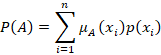 and this probability is characterized by the fuzzy constraint B.
The key concepts and operations related to discrete Z-numbers are thoroughly discussed in references [17-26].
Definition 2. Comparison of Z-numbers [26] based on the principle of fuzzy Pareto optimality (FPO). The principle of FPO makes it possible to find the degree of Pareto optimality of multiattribute alternatives. This principle is used in the analysis of Z-numbers as multi-attribute alternatives, where one attribute is related to the corresponding reliability. In accordance with this principle, the direct comparison of Z-numbers  and
and  allows one to find the total degree of optimality of Z-numbers:
  and
and  .These degrees are determined on several components, ranging from a minimum of 0 to a maximum of 2, which indicate the extent to which one Z-number dominates another.
  is considered higher than
  if
if  .
.
Definition 3 [26]. Distance between Z-numbers. The distance measure between two Z-numbers  and
and  is defined as follows.
 (1)
(1)
where 
 ,
, .
.
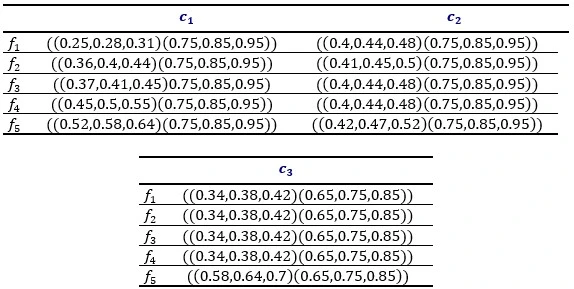
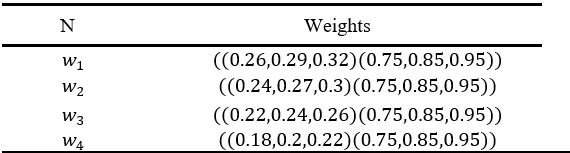
Consider a MCDM problem in which the available information is represented using Z-numbers. Five candidate materials- f₁: AA6061T6, f₂: AA2024T6, f₃: AA2014T6, f₄: AA7075T6, and f₅: Ti-6Al-4V are analyzed for their suitability in structural applications [27-29]. The evaluation is based on four key criteria: c₁: Specific Strength, c₂: Specific Modulus, c₃: Corrosion Resistance and c₄: Cost Category [27]. Criteria c₁, c₂, and c₃ are beneficial, while c₄ is a non-beneficial criterion. Both the criteria values for each material and their importance weights are represented as Z-numbers, capturing both fuzziness and reliability in the assessment. Tables 1 and 2 provide the detailed Z-number values for the materials and criteria weights used in this study.
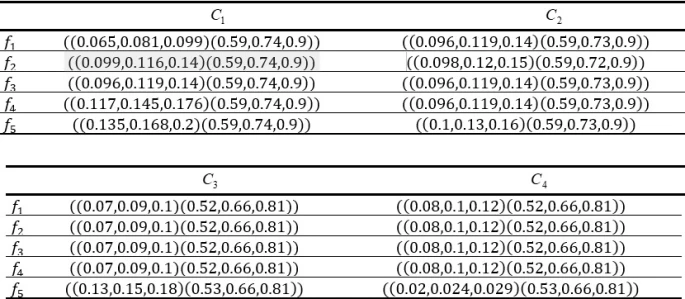
This problem is solved using the PROMETHEE approach, which considers Z-number–based data [25,30]. The first step includes constructing a weighted decision matrix by aggregating the importance weights of the criteria with their respective evaluation values. This process incorporates both the relative significance of each criterion and the uncertainty present in the data. This results in the weighted normalized Z-numbers, which reflect both the performance and reliability of each alternative. The weighted normalized values are presented in table 3.
At the second stage, the following distance values were found for comparison of alternatives and  by all criteria:
 ,
,  ,
, . (Definition 3) [30].

 is the ideal solution.
We assume that  if
if  [30]. Next, the preference function is defined as follows.
 (2)
(2)
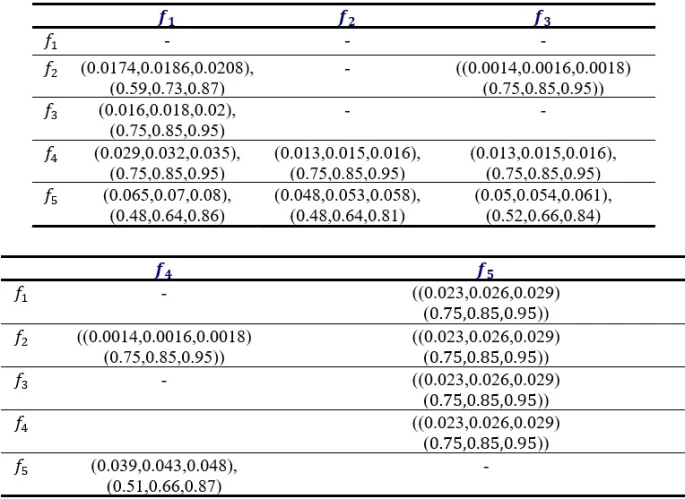
The obtained results are given in table 4.
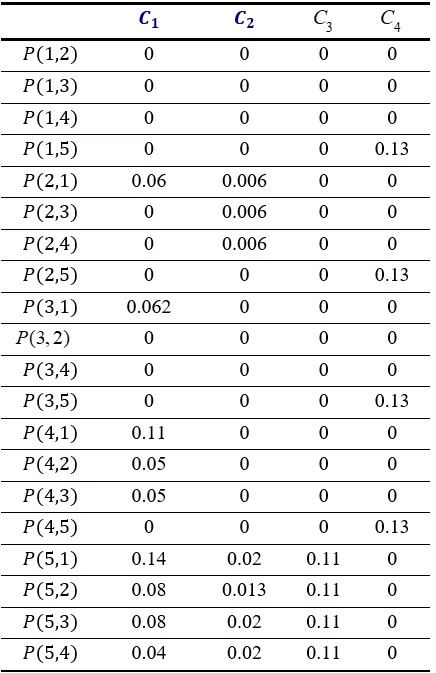
In the third stage, the Z-number–valued preference index is calculated to determine the outranking relation 
 (3)
(3)
The values obtained are presented in table 5 below.
Ranking of alternatives will be computed during the fourth stage in the form of leaving and entering flows. It is an important process in assessing alternatives’ performance [30,31]:
 (4)
(4)
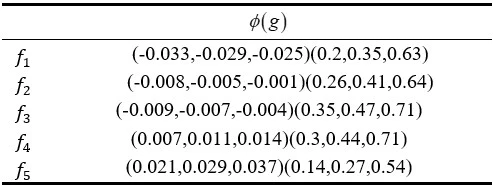
Here, n indicates the number of alternatives. The outcomes are represented below in table 6.
In the fifth stage, the net flow is calculated using the following formula [30]:
 (5)
(5)
The calculated net flow results are presented in table 7.
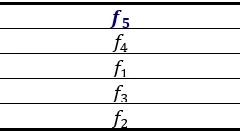
In the sixth stage, the alternatives are ranked following definition 2. The results of this ranking are presented in table 8.
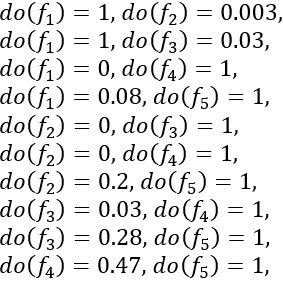
 is identified as the best choice. This is based on the dominance and evaluation criteria used in the analysis.
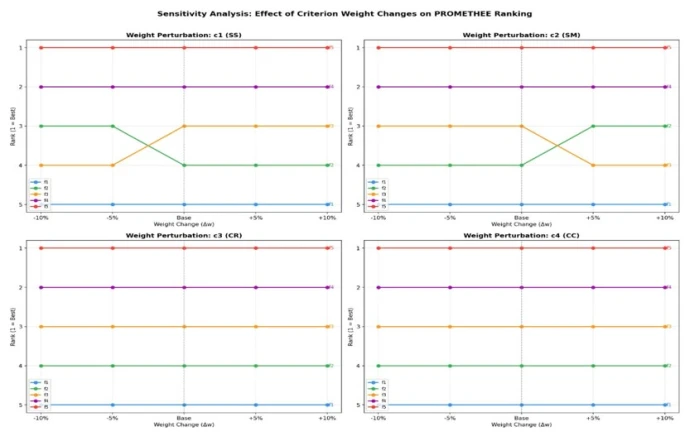
 To evaluate the stability and robustness of the obtained ranking, a sensitivity analysis was performed. In this case, each of the criteria weights is varied by 5% and 10% of their original value, with the rest of the weights adjusted proportionally in order to ensure that their sum is 1.0. A total of 16 different scenarios were tested. As shown in figure 1, the best alternative ( : Ti-6Al-4V) remained consistently at the first rank in all scenarios, confirming the reliability of the decision model. Minor rank swaps were only observed between
  and
and  when the weight of c1 was decreased or c2 was increased, but these changes did not affect the overall selection of the optimal material.
This paper examines the use of the PROMETHEE approach to solve a material selection problem. Z-numbers are used to indicate the values and importance weights for each criterion, taking reliability and uncertainty into account while making decisions. A comparison analysis based on the fuzzy Pareto optimality principle is utilized to rate the options. This helps to perform an analysis of multiple criteria with partial certainty in the information provided, thus creating a stronger and more realistic decision-making model by combining PROMETHEE with Z-number modeling. As further research direction, the current proposed approach could be improved further by integrating PROMETHEE with other MCDM methods like TOPSIS, VIKOR or AHP for Z-information problems. Moreover, sensitivity analysis of the proposed model to investigate robustness based on different degrees of experts’ reliability could be an interesting area for investigation.
1 S.K. Sahoo, B.B. Choudhury, P.R. Dhal, Spectrum of Mechanical Engineering and Operational Research 1(1) (2024) 189. https://doi.org/10.31181/smeor11202417
2 I. Emovon, O.S. Oghenenyerovwho, Results in Materials 7 (2020) 100115. https://doi.org/10.1016/j.rinma.2020.100115
3 Soni, P.K. Das, M.J. Sarma, International Journal of Materials and Product Technology 66(3) (2023) 233–251.
4 M. Şahin, Soft Computing 28 (2024) 5437.
5 R. Kumar, A. Jagadish, R. Amitava, Procedia Materials Science 6 (2014) 590. https://doi.org/10.1016/j.mspro.2014.07.073
6 S. Chatterjee, S. Chakraborty, Materials Today: Proceedings 44(1) (2021) 1621.
7 A.A.A. Rahim, S. Ramesh, N.M. Musa, AIP Conference Proceedings 2643 (2023) 050013. https://doi.org/10.1063/5.0111228
8 S.K. Anand, S. Mitra, International Journal of Emerging Technologies in Engineering Research 9(6) (2021).
9 M.C.R.Muthaiah, S. Senthilraja, International Journal on Engineering Applications (IREA) 13(6) (2025) 605. https://doi.org/10.15866/irea.v13i6.25039
10 A.V. Khandekar, S. Chakraborty, International Journal of Industrial and Systems Engineering 20(1) (2015) 117. https://doi.org/10.1504/IJISE.2015.069003
11 A. Balakrishna, G.R. Chandra, B. Gogulamudi, C. Someswararao, Engineering 3(9) (2011) 921. https://doi.org/10.4236/eng.2011.39113
12 A.F. Hussein, B.I. Jameel, K.K. Abd, Association of Arab Universities Journal of Engineering Sciences, 25(2) (2018) 137.
13 D.P. Singh, S. Avikal, H. Singh, S. Monga, Lecture Notes in Mechanical Engineering (2025) 377.
14 L. Abdullah, W. Chan, A. Afshari, Journal of Industrial Engineering International 15 (2019) 271. https://doi.org/10.1007/s40092-018-0289-z
15 S.R. Maity, S. Chakraborty, The International Journal of Advanced Manufacturing Technology 78 (2025) 1537. https://doi.org/10.1007/s00170-014-6760-0
16 M. Çitil, Thermal Science 26(2) (2022) 613. https://doi.org/10.2298/TSCI22S2613C
17 R.A. Aliev, A.V. Alizadeh, O.H. Huseynov, Information Sciences 290 (2015) 134. https://doi.org/10.1016/j.ins.2014.08.024
18 R.A. Aliev, A.V. Alizadeh, O.H. Huseynov, K.I. Jabbarova, International Journal of Intelligent Systems 30(5) (2015) 563. https://doi.org/10.1002/int.21709
19 R.A. Aliev, O.H. Huseynov, World Scientific 13(05) (2014) 1051. https://doi.org/10.1142/S0219622014500709
20 R.A. Aliev, O.H. Huseynov, R.R. Aliyev, A.V. Alizadeh, World Scientific (2015) 316p.
21 R.A. Aliev, O.H. Huseynov, R.R. Aliyev, Information Sciences 694 (2025) 121703. https://doi.org/10.1016/j.ins.2024.121703
22 K.I. Jabbarova, R. Aliyev, Lecture Notes in Networks and Systems 1472 (2025) 324. https://doi.org/10.1007/978-3-031-94788-9_40
23 K.I. Jabbarova, Lecture Notes in Networks and Systems 1472 (2025) 170. https://doi.org/10.1007/978-3-031-94788-9_21
24 L. Hasanova, K.I. Jabbarova, Lecture Notes in Networks and Systems 1141 (2024) 202. https://doi.org/10.1007/978-3-031-76283-3_29
25 K.I. Jabbarova, O.H. Huseynov, A.I. Jabbarova, Lecture Notes in Networks and Systems 718 (2024) 352. https://doi.org/10.1007/978-3-031-51521-7_44
26 K.I. Jabbarova, A.V. Alizadeh, Advances in Intelligent Systems and Computing 1306 (2020) 498. https://doi.org/10.1007/978-3-030-64058-3_62
27 V.M. Athawale, S. Chakraborty, Materials: Design and Applications 226(4) (2012) 266. https://doi.org/10.1177/1464420712448979
28 N. Gurbanov, Advanced Physical Research 5(3) (2023) 146.
29 N.A.Gurbanov, Progress in Physics of Metals 25(2) (2024) 364. https://doi.org/10.15407/ufm.25.02.364
30 K.I. Jabbarova, A.I. Jabbarova, Advances in Intelligent Systems and Computing 1323 (2021) 287. https://doi.org/10.1007/978-3-030-68004-6_37
K.I. Jabbarova, N.A. Gurbanov, Y.A. Abdulazimova, M.M. Yaşar, An application of the PROMETHEE method to material selection problems under Z-information, UNEC J. Eng. Appl. Sci. 6(1) (2026) 80-89. https://doi.org/10.61640/ujeas.2026.0507
Anyone you share the following link with will be able to read this content:

This article is licensed under the Creative Commons Attribution ( CC BY 4.0 ) License, which permits unrestricted use, distribution, and reproduction in any medium, provided the original author and source are credited.
S.K. Sahoo, B.B. Choudhury, P.R. Dhal, Spectrum of Mechanical Engineering and Operational Research 1(1) (2024) 189. https://doi.org/10.31181/smeor11202417
I. Emovon, O.S. Oghenenyerovwho, Results in Materials 7 (2020) 100115. https://doi.org/10.1016/j.rinma.2020.100115
Soni, P.K. Das, M.J. Sarma, International Journal of Materials and Product Technology 66(3) (2023) 233–251.
M. Şahin, Soft Computing 28 (2024) 5437.
R. Kumar, A. Jagadish, R. Amitava, Procedia Materials Science 6 (2014) 590. https://doi.org/10.1016/j.mspro.2014.07.073
S. Chatterjee, S. Chakraborty, Materials Today: Proceedings 44(1) (2021) 1621.
A.A.A. Rahim, S. Ramesh, N.M. Musa, AIP Conference Proceedings 2643 (2023) 050013. https://doi.org/10.1063/5.0111228
S.K. Anand, S. Mitra, International Journal of Emerging Technologies in Engineering Research 9(6) (2021).
M.C.R.Muthaiah, S. Senthilraja, International Journal on Engineering Applications (IREA) 13(6) (2025) 605. https://doi.org/10.15866/irea.v13i6.25039
A.V. Khandekar, S. Chakraborty, International Journal of Industrial and Systems Engineering 20(1) (2015) 117. https://doi.org/10.1504/IJISE.2015.069003
A. Balakrishna, G.R. Chandra, B. Gogulamudi, C. Someswararao, Engineering 3(9) (2011) 921. https://doi.org/10.4236/eng.2011.39113
A.F. Hussein, B.I. Jameel, K.K. Abd, Association of Arab Universities Journal of Engineering Sciences, 25(2) (2018) 137.
D.P. Singh, S. Avikal, H. Singh, S. Monga, Lecture Notes in Mechanical Engineering (2025) 377.
L. Abdullah, W. Chan, A. Afshari, Journal of Industrial Engineering International 15 (2019) 271. https://doi.org/10.1007/s40092-018-0289-z
S.R. Maity, S. Chakraborty, The International Journal of Advanced Manufacturing Technology 78 (2025) 1537. https://doi.org/10.1007/s00170-014-6760-0
M. Çitil, Thermal Science 26(2) (2022) 613. https://doi.org/10.2298/TSCI22S2613C
R.A. Aliev, A.V. Alizadeh, O.H. Huseynov, Information Sciences 290 (2015) 134. https://doi.org/10.1016/j.ins.2014.08.024
R.A. Aliev, A.V. Alizadeh, O.H. Huseynov, K.I. Jabbarova, International Journal of Intelligent Systems 30(5) (2015) 563. https://doi.org/10.1002/int.21709
R.A. Aliev, O.H. Huseynov, World Scientific 13(05) (2014) 1051. https://doi.org/10.1142/S0219622014500709
R.A. Aliev, O.H. Huseynov, R.R. Aliyev, A.V. Alizadeh, World Scientific (2015) 316p.
R.A. Aliev, O.H. Huseynov, R.R. Aliyev, Information Sciences 694 (2025) 121703. https://doi.org/10.1016/j.ins.2024.121703
K.I. Jabbarova, R. Aliyev, Lecture Notes in Networks and Systems 1472 (2025) 324. https://doi.org/10.1007/978-3-031-94788-9_40
K.I. Jabbarova, Lecture Notes in Networks and Systems 1472 (2025) 170. https://doi.org/10.1007/978-3-031-94788-9_21
L. Hasanova, K.I. Jabbarova, Lecture Notes in Networks and Systems 1141 (2024) 202. https://doi.org/10.1007/978-3-031-76283-3_29
K.I. Jabbarova, O.H. Huseynov, A.I. Jabbarova, Lecture Notes in Networks and Systems 718 (2024) 352. https://doi.org/10.1007/978-3-031-51521-7_44
K.I. Jabbarova, A.V. Alizadeh, Advances in Intelligent Systems and Computing 1306 (2020) 498. https://doi.org/10.1007/978-3-030-64058-3_62
V.M. Athawale, S. Chakraborty, Materials: Design and Applications 226(4) (2012) 266. https://doi.org/10.1177/1464420712448979
N. Gurbanov, Advanced Physical Research 5(3) (2023) 146.
N.A.Gurbanov, Progress in Physics of Metals 25(2) (2024) 364. https://doi.org/10.15407/ufm.25.02.364
K.I. Jabbarova, A.I. Jabbarova, Advances in Intelligent Systems and Computing 1323 (2021) 287. https://doi.org/10.1007/978-3-030-68004-6_37
 UNEC Journal of Engineering and Applied Sciences