UNEC Journal of Engineering and Applied Sciences Volume 5, No 2, pages 104-109 (2025) Cite this article,  716 https://doi.org/10.61640/ujeas.2025.1209
In this work, the photoluminescence properties of ZnIn₂S₄ chalcogenide crystals doped with Nd³⁺ ions were investigated. As a result of spectral measurements carried out in the wavelength range of 550–930 nm, three main emission peak groups corresponding to the internal transitions of Nd³⁺ ions ⁴G₅/₂ → ⁴I₉/₂, ⁴F₉/₂ → ⁴I₉/₂ and ⁴F₃/₂ → ⁴I₉/₂ were identified. As a result of increasing the diffraction grating permittivity, a fine structure due to the Stark effect was observed in each of these peaks. Also, lowering the temperature weakened the effect of phonons, leading to a narrowing of the peaks and an increase in the emission intensity. The obtained results demonstrate the high sensitivity of Nd³⁺ ions to crystal field and temperature variations and indicate the prospects of this material in photonic applications.
Recently, ternary metal chalcogenide compounds, especially those of the AB₂X₄ type (where A and B are metal elements and X is a chalcogen element such as sulfur, selenium or tellurium), have attracted the attention of the scientific community due to their interesting optical and electronic properties. CdIn₂S₄, ZnIn₂Se₄, CdGa₂S₄, ZnGa₂S₄ and other similar materials belonging to this group have a wide range of applications and have high potential as semiconductors [1-10]. These compounds are of great importance, especially for use in photocatalysis, solar energy conversion, optoelectronics and sensor technologies. The tunable energy gaps, high photostability and environmental compatibility of these materials make them an alternative to traditional semiconductors [11-19]. One of the compounds belonging to this group, zinc indium sulfide (ZnIn₂S₄), occupies an important place due to its light absorption capacity in the visible light spectrum, high chemical stability and environmental safety. Due to its layered crystal structure, ZnIn₂S₄ provides effective charge separation and transport, which significantly improves its optical performance [5,18-25]. Optical properties of the ZnIn₂S₄ compound, such as light absorption behavior, photoluminescence properties and energy gap, determine the wide application of this material in light energy harvesting and photoelectronic technologies. In addition, the study of the structural structure, morphological features and the effect of external factors such as temperature and pressure on the optical properties of the ZnIn₂S₄ material is of great importance in terms of optimizing the functional applications of the ZnIn₂S₄ material [26-34]. On the other hand, as is known, rare earth ions have a developed system of electronic states associated with the ground state with forbidden transitions in crystal matrices. Often, such metastable states, which have a duration of milliseconds or more, allow the creation and maintenance of a significant part of the activating ions without resorting to particularly strong excitations. It is known that the photoluminescence of these compounds occurs due to the intra-center transitions of rare earth elements [34-40]. In this regard, ZnIn₂S₄:REE type ternary alkaline earth chalcogenide semiconductors are promising. In this research work, the emission properties of the neodymium-doped ZnIn₂S₄ compound are systematically investigated, the effect of the changes occurring under the influence of neodymium on the optical behavior is analyzed, and the potential of the material for application in modern optoelectronics is evaluated.
Layered metal chalcogenides show strong sensitivity of their electronic and luminescent properties to defects, impurities, and local crystal-field effects, making doping an effective approach for property modulation [41–48]. In particular, rare earth incorporation can introduce localized 4f states that alter recombination processes and generate additional emission channels [42,49–52]. In ZnIn₂S₄, rare earth ions are expected to modify the electronic structure and defect environment, leading to changes in emission intensity, spectral position, and carrier lifetime [53–60]. Neodymium is especially attractive due to its characteristic intra-4f transitions, which produce stable luminescence in the visible and near-infrared regions [35]. Therefore, investigating Nd-doped ZnIn₂S₄ provides insight into host–activator interactions and supports the development of efficient optoelectronic materials for light-emitting and energy-related applications.
Photoluminescence (PL) measurements were carried out using a PL/PLE/Raman spectrometer device manufactured in Japan. The emission of the samples was studied using lasers with different wavelengths: 532 nm (Nd- YAG) and 785 nm. Photoluminescence from the sample was scattered by a grating (100 g/mm−1) monochromator MS 5207 I and MS 3704 I (SOL Instruments, Inc), detected by a CCD multiplier DU 491A-1.7.
ZnIn₂S₄ single crystals were obtained by gas phase transport. The initial Zn, In, S and Nd elements (all 99.9% pure) were synthesized as reaction products and placed in a transparent quartz ampoule, which was sealed at a pressure of 1.3 × 10⁻³ Pa. The ampoule was placed in a horizontal furnace, the growth zone was maintained at 940 °C, and the source zone was maintained at 830 °C. The transport process was carried out by diffusion, and the temperature was controlled by a platinum-rhodium thermocouple.
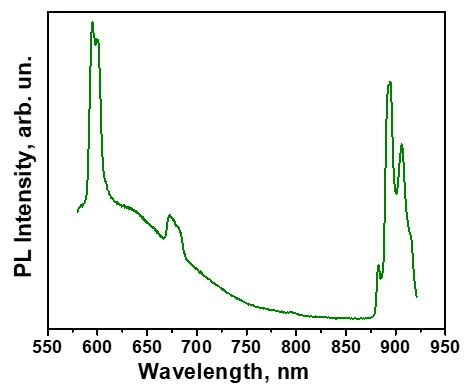
In this work, the optical properties of Nd³⁺ ions in a chalcogenide matrix and the factors affecting the internal transitions of these ions were systematically investigated. The photoluminescence (FL) spectra of the Nd³⁺-doped ZnIn₂S₄ compound are given in figure 1. Spectral measurements were carried out in the wavelength range of 550–930 nm and three main emission peak groups were observed. These peaks are related to the characteristic 4f-4f ⁴G₅/₂ → ⁴I₉/₂, ⁴F₉/₂ → ⁴I₉/₂, ⁴F₃/₂ → ⁴I₉/₂ internal electronic transitions of Nd³⁺ ions and cover the regions of 584–610 nm, 667–687 nm,880–920 nm, respectively [21,35].
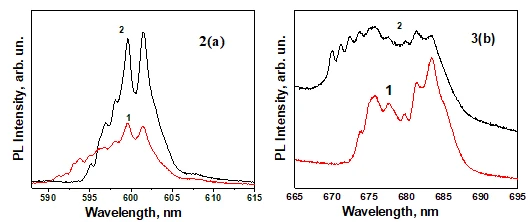
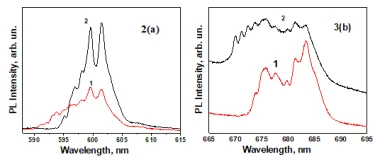
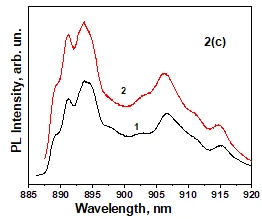
Initially, the transitions were observed as two, one and three narrow peaks, respectively. As a result of increasing the resolution of the diffraction grating, the presence of a fine structure in each of these peaks became clearly visible. This is due to the splitting of energy levels due to the influence of the internal electric field created by the crystal field (Stark effect). When neodymium ions are located in a chalcopyrite crystal, the electric field there (asymmetric local field) can split the energy levels of the ion.
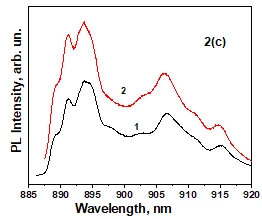
Figures 2a, 2b and 2c show the fine structure and temperature dependence of the photoluminescence peaks in the wavelength regions of 584–610 nm, 667–687 nm and 880–920 nm. Accordingly, the first peak is split into eight, the second peak into six and the third peak into seven fine peaks. These observations are the result of the interaction of Nd³⁺ ions with local symmetry and defects in the crystal field. In particular, the presence of chalcogen vacancies and other structural defects in the material increases the depth of this splitting.
In the next stage of the experiment, the effect of temperature on the photoluminescence peaks was investigated. Lowering the temperature reduces the number of phonons and weakens the radiationless relaxation processes, which resulted in further thinning of the peaks and an increase in the emission efficiency. All the observations noted indicate a high sensitivity of the energy levels of Nd³⁺ ions in the ZnIn₂S₄:Nd³⁺ system to both crystal field variations and temperature changes. These properties increase the importance of the material for potential laser, optoelectronic and other photonic applications.
Studies have shown that the fine structure of the photoluminescence peaks observed in ZnIn₂S₄ crystals doped with Nd³⁺ ions is due to the Stark effect induced by the crystal field. The separation of the peaks into multiple fine components reflects the effects of local symmetry violations and defects. Lowering the temperature led to a narrowing of the peaks and an increase in the emission efficiency. These features indicate the prospects of the ZnIn₂S₄:Nd³⁺ crystal for optoelectronics and photonic devices and open up the possibility of optimizing these properties in the future through ion concentration and crystal engineering.
1 S.G. Asadullayeva, N.A. Ismayilova, T.G. Naghiyev, Modern Physics Letters B 37(34) (2023) 2350166. https://doi.org/10.1142/S021798492350166X
2 A.I. Isayev,S.I. Mekhtiyeva, H.I. Mammadova et al. UNEC J. Eng. Appl. Sci. 4(1) (2024) 55. https://doi.org/10.61640/ujeas.2024.0505
3 S.G. Asadullayeva, Z.A. Jahangirli, T.G. Naghiyev, A.S. Abiyev, Curr. Appl. Phys. 76 (2025) 39. http://doi.org/10.1016/j.cap.2025.05.007
4 J. Li, Y. Lin, M. Zhang, Y. Peng, X. Wei, et al., J. Appl. Phys. 133 (2023) 105702. https://doi.org/10.1063/5.0136862
5 M. Yousaf, M.A. Saeed, A.R. Mat Isa, H.A. Rahnamaye Aliabad, and M.R. Sahar, Chin. Phys. Lett. 30 (2013) 077402. https://doi.org/10.1088/0256-307X/30/7/077402
6 E.M. Huseynov, T.G. Naghiyev, Applied Physics A 128(2) (2022) 115. https://doi.org/10.1007/s00339-022-05265-x
7 P. Rodríguez-Hern´andez, A. Mu˜noz, J. Gonz´alez, J.A. Sans, V.P. Cuenca-Gotor, J. Ib´a˜nez, C. Popescu, F.J. Manj´on, Phys. Chem. Chem. Phys. 23 (2021) 6841. https://doi.org/10.1039/D0CP06417C
8 O. Gomis, R. Vilaplana, F.J. Manj´on, D. Santamaría-P´erez, D. Errandonea, E. P´erezGonz´alez, J. L´opez-Solano, P. Rodríguez-Hern´andez, A. Mu˜noz, I.M. Tiginyanu, V.V. Ursaki, Mater. Res. Bull. 48 (2013) 2128. https://doi.org/10.1016/j.materresbull.2013.02.037
9 R.S. Madatov, F.G. Asadov, E.G. Asadov, T.G. Naghiyev, Journal of the Korean Physical Society 74 (2019) 508. https://doi.org/10.3938/jkps.74.508
10 Z.A. Jahangirli, S.G. Asadullayeva, I.R. Amiraslanov et al., Indian J. Phys. 99(6) (2025) 2087. https://doi.org/10.1007/s12648-024-03452-5
11 Q. Shah, G. Murtaza, M. Shafiq, A. Nicola, Chin. J. Phys. 85 (2023) 1. https://doi.org/10.1016/j.cjph.2023.05.016
12 W.-T. Kim, M.-S. Jin, S. Hyeon, Y.-G. Kim, B.- S. Park, Solid State Commun. 74 (1990) 123. https://doi.org/10.1016/0038-1098(90)90618-L
13 N.A Ismayilova, S.H. Jabarov, Ukrainian Journal of Physics 69 (2024) 754. https://doi.org/10.15407/ujpe69.10.754
14 T.G. Naghiyev, R.M. Rzayev, Modern Physics Letters B 35(31) (2021) 2150469. https://doi.org/10.1142/S0217984921504698
15 E.G. Asadov, O.B. Tagiev, G.S. Gadzhieva, A.H. Asadova, et al., Solid State Commun. 356 (2022) 114933. https://doi.org/10.1016/j.ssc.2022.114933
16 J. Li, M. Zhang, Y. Peng, X. We, et al., J. Appl. Phys. 133 (2023) 105702. https://doi.org/10.1063/5.0136862
17 N.A. Ismayilova, J Supercond Nov Magn 38 80 (2025). https://doi.org/10.1007/s10948-025-06920-z
18 Xiaoshu Jiang, Walter R.L. Lambrecht, Phys. Rev. B 69 (2004) 035201. https://doi.org/10.1103/PhysRevB.69.035201
19 O. Vigil, S. Lopez, E. Morris, F. Leccabue, J. Appl. Phys. 62 (1987) 653. https://doi.org/10.1063/1.339764
20 T.G. Naghiyev, U.R. Rzayev, E.M. Huseynov, I.T. Huseynov, S.H. Jabarov, UNEC J. Eng. Appl. Sci. 2(1) (2022) 85.
21 S.G. Asadullayeva, N.A. Ismayilova, Solid State Commun. 394 (2024) 115725. https://doi.org/10.1016/j.ssc.2024.115725
22 M. Yousaf, M.A. Saeed, A.R. Mat Isa, H.A. Rahnamaye Aliabad, and M.R. Sahar, Chin. Phys. Lett. 30(7) (2013) 077402. https://doi.org/10.1088/0256-307X/30/7/077402
23 O.B. Tagiyev, T.D. Ibragimov, E.G. Asadov, F.A. Kazimova and et al. J. Appl. Phys. 133 (2023)135103. https://doi.org/10.1063/5.0138667
24 R.Yang, L. Mei, Y. Fan, Q. Zhang, R. Zhu, R. Amal, Z. Yin, Z. Zeng, Small metod 5(2021) 2100887. https://doi.org/10.1002/smtd.202100887
25 N. Ismayilova, S Asadullayeva, Indian Journal of Physics 98(3) (2024) 1103. https://doi.org/10.1007/s12648-023-02858-x
26 L. Valdman, V. Mazanek, and P. Marvan, Adv. Opt. Mater. 9 (2021) 2100845. https://doi.org/10.1002/adom.202100845
27 G. Yadav, Md. Ahmaruzzaman, Inorganic Chemistry Communications 138 (2022) 109288. https://doi.org/10.1016/j.inoche.2022.109288
28 W.-K. Chong, B.-J. Ng, Y.J. Lee, L.-L. Tan, L.K. Putri et.al., Nat Commun 14 (2023) 7676. https://doi.org/10.1038/s41467-023-43331-x
29 S.G. Asadullayeva, R.A. Ahmedov, A.A. Hadieva et al. UNEC J. Eng. Appl. Sci. 3(2) (2023) 66. https://doi.org/10.61640/ujeas.2023.1209
30 S.G. Asadullayeva, Z.A. Jahangirli, T.G. Naghiyev, D.A. Mammadov, Phys. Status Solidi B 258(8) (2021) 2100101. https://doi.org/10.1002/pssb.202100101
31 G. Zhang, H. Wu, D. Chen, N. Li, Q. Xu, H. Li, J. He, Green Energy & Environment 7 (2022) 176. https://doi.org/10.1016/j.gee.2020.12.015
32 S.G. Asadullayeva, N.A. Ismayilova, E.H. Alizade, N.T. Mamedov, A.I. Bayramov, M.A. Musayev, I.I. Abbasov, Bull Mater Sci 47 (2024) 115. https://doi.org/10.1007/s12034-024-03197-1Sadhana(0123456789().,-volV)FT3](012345 6789().,-volV)
33 H. Wang, Y. Wu, X. Yuan, G. Zeng, J. Zhou, X. Wang, and J. W. Chew, Adv. Mater. 30 (2018) 1704561. https://doi.org/10.1002/adma.201704561
34 S.G. Asadullayeva, N.A. Ismayilova, S.H. Jabarov, SOCAR Proceedings 3 (2024) 118. http://dx.doi.org/10.5510/OGP20240301001
35 S.G. Asadullayeva, Z.A. Jahangirli, Eur. Phys. J. B 98 (2025) 142. https://doi.org/10.1140/epjb/s10051-025-00990-7
36 G. Stamov, V.V. Zalamai, N.N. Syrbu, A.V. Tiron, J. Phys. Chem. Solids 136 (2020) 109016 . https://doi.org/10.1016/j.jpcs.2019.05.013
37 S. Shen, P. Guo, and L. Zhao, J. Solid State Chem. 184 (2011) 2250. https://doi.org/10.1016/j.jssc.2011.06.033
38 T.X. Wang, S.H. Xu, F.X. Yang, Mater. Lett. 83 (2012) 46. https://doi.org/10.1016/j.gee.2018.03.001
39 S.G. Asadullayeva, Z.A. Jahangirli, M.A. Musayev, Q.Y. Eyyubov, A.S. Abiyev, Phys. Solid State 67(6) (2025) 429. https://doi.org/10.1134/S1063783425601067
40 Y. Yan, Z. Chen, X. Cheng, W. Shi, Catalysts 13 (2023) 967. https://doi.org/10.3390/catal13060967
41 R.F. Babayeva, T.G. Naghiyev, Modern Physics Letters B 37(21) (2023) 2350058. https://doi.org/10.1142/S0217984923500586
42 G.S. Hadjieva, K.O. Taghiyev, E.G. Asadov, F.A. Kazimova, T.Sh Ibragimova, O. B. Tagiyev, Mod. Phys. Lett. B 34(31) (2020) 2050344. https://doi.org/10.1142/%20S0217984920503443
43 I.I. Aliyev, R.M. Rzayev, Kh.M. Hashimov, C.A. Ahmedova, T.G. Naghiyev, Modern Physics Letters B 38(25) (2024) 2450232. https://doi.org/10.1142/S0217984924502324
44 T.G. Naghiyev, R.F. Babayeva, Y.I. Aliyev, Eur. Phys. J. B 97 (2024) 86. https://doi.org/10.1140/epjb/s10051-024-00731-2
45 B.G. Tagiyev, O.B. Tagiyev, A.I. Mammadov, Vu Xuan Quang, T.G. Naghiyev, S.H. Jabarov, M.S. Leonenya, G.P. Yablonskii, N.T. Dang, Physica B: Condensed Matter 478 (2015) 58. https://doi.org/10.1016/j.physb.2015.08.061
46 R.S. Madatov, A.S. Alekperov, N.N. Gadzhieva, F.G. Asadov, Sh.A. Allahverdiev, E.G. Asadov, T.G. Naghiyev, International Journal of Modern Physics B 33(09) (2019) 1950066. https://doi.org/10.1142/S0217979219500668
47 T.G. Naghiyev, R.F. Babayeva, A.S. Abiyev, Eur. Phys. J. B 97 (2024) 131. https://doi.org/10.1140/epjb/s10051-024-00771-8
48 A.Sh. Abdinov, R.F. Babayeva, Y.I. Aliyev, International Journal of Modern Physics B 39(12) (2025) 2550089. https://doi.org/10.1142/S0217979225500894
49 A.Sh. Abdinov, R.F. Babaeva, A.T. Bagirova, R.M. Rzaev, Inorg. Mater. 42 (2006) 937. https://doi.org/10.1134/S0020168506090020
50 A.Sh. Abdinov, R.F. Babaeva, R.M. Rzaev, S.I. Amirova, Inorg. Mater. 48 (2012) 559. https://doi.org/10.1134/S0020168512060015
51 A.Sh. Abdinov, R.F. Babaeva, R.M. Rzaev, Inorg. Mater. 48 (2012) 781. https://doi.org/10.1134/S0020168512080018
52 R. Behjatmanesh-Ardakani, R. Rzayev, Chemical Review and Letters, 7(6) (2024) 1022. https://doi.org/10.22034/crl.2024.474971.1412
53 K.T. Dovranov, G.T. Imanova, V.V. Loboda, M.T. Normuradov, I.R. Bekpulatov, UNEC J. Eng. Appl. Sci. 4(2) (2024) 37. https://doi.org/10.61640/ujeas.2024.1204
54 A.Sh. Abdinov, R.F. Babayeva, S.I. Amirova, N.A. Rahimova, E.A. Rasulov, UNEC J. Eng. Appl. Sci. 5(1) (2025) 55. https://doi.org/10.61640/ujeas.2025.0506
55 A.I. Isayev, S.I. Mekhtiyeva, H.I. Mammadova, R.I. Alekberov, Q.M. Ahmadov, N.N. Eminova, A.Ch. Mammadova, L.A. Aliyeva, L.V. Afandiyeva, R.F. Sadikhli, UNEC J. Eng. Appl. Sci. 4(1) (2024) 55. https://doi.org/10.61640/ujeas.2024.0505
56 M.A. Jafarov, V.M. Salmanov, A.H. Huseynov, R.M. Mamedov, T.A. Mamedova, F.S. Ahmedova, A.B. Aliyeva, UNEC J. Eng. Appl. Sci. 3(2) (2023) 54. https://doi.org/10.61640/ujeas.2023.1207
57 A.O. Dashdemirov, A.S. Alekperov, Y.I. Aliyev, UNEC J. Eng. Appl. Sci. 3(1) (2023) 28. https://doi.org/10.61640/ujeas.2023.0505
58 T.G. Naghiyev, E.M. Huseynov, UNEC J. Eng. Appl. Sci. 3(1) 2023 10. https://doi.org/10.61640/ujeas.2023.0502
59 T.D. Ibragimov, A.M. Hashimov, G.B. Ibragimov, R.M. Rzayev, Fullerenes, Nanotubes and Carbon Nanostructures 29(12) (2021) 951. https://doi.org/10.1080/1536383X.2021.1920579
60 F. Behmagham, S. Arshadi, E. Vessally, T.G. Naghiyev, R. Rzayev, Dharmesh Sur, Subbulakshmi Ganesan, Computational and Theoretical Chemistry 1243 (2025) 114976. https://doi.org/10.1016/j.comptc.2024.114976
S.G. Asadullayeva, Sh.Sh. Amirov, Photoluminescence properties and the influence of the Stark effect of a ZnIn₂S₄ crystal doped with Nd, UNEC J. Eng. Appl. Sci. 5(2) (2025) 104-109. https://doi.org/10.61640/ujeas.2025.1209
Anyone you share the following link with will be able to read this content:

This article is licensed under the Creative Commons Attribution ( CC BY 4.0 ) License, which permits unrestricted use, distribution, and reproduction in any medium, provided the original author and source are credited.
S.G. Asadullayeva, N.A. Ismayilova, T.G. Naghiyev, Modern Physics Letters B 37(34) (2023) 2350166. https://doi.org/10.1142/S021798492350166X
A.I. Isayev,S.I. Mekhtiyeva, H.I. Mammadova et al. UNEC J. Eng. Appl. Sci. 4(1) (2024) 55. https://doi.org/10.61640/ujeas.2024.0505
S.G. Asadullayeva, Z.A. Jahangirli, T.G. Naghiyev, A.S. Abiyev, Curr. Appl. Phys. 76 (2025) 39. http://doi.org/10.1016/j.cap.2025.05.007
J. Li, Y. Lin, M. Zhang, Y. Peng, X. Wei, et al., J. Appl. Phys. 133 (2023) 105702. https://doi.org/10.1063/5.0136862
M. Yousaf, M.A. Saeed, A.R. Mat Isa, H.A. Rahnamaye Aliabad, and M.R. Sahar, Chin. Phys. Lett. 30 (2013) 077402. https://doi.org/10.1088/0256-307X/30/7/077402
E.M. Huseynov, T.G. Naghiyev, Applied Physics A 128(2) (2022) 115. https://doi.org/10.1007/s00339-022-05265-x
P. Rodríguez-Hern´andez, A. Mu˜noz, J. Gonz´alez, J.A. Sans, V.P. Cuenca-Gotor, J. Ib´a˜nez, C. Popescu, F.J. Manj´on, Phys. Chem. Chem. Phys. 23 (2021) 6841. https://doi.org/10.1039/D0CP06417C
O. Gomis, R. Vilaplana, F.J. Manj´on, D. Santamaría-P´erez, D. Errandonea, E. P´erezGonz´alez, J. L´opez-Solano, P. Rodríguez-Hern´andez, A. Mu˜noz, I.M. Tiginyanu, V.V. Ursaki, Mater. Res. Bull. 48 (2013) 2128. https://doi.org/10.1016/j.materresbull.2013.02.037
R.S. Madatov, F.G. Asadov, E.G. Asadov, T.G. Naghiyev, Journal of the Korean Physical Society 74 (2019) 508. https://doi.org/10.3938/jkps.74.508
Z.A. Jahangirli, S.G. Asadullayeva, I.R. Amiraslanov et al., Indian J. Phys. 99(6) (2025) 2087. https://doi.org/10.1007/s12648-024-03452-5
Q. Shah, G. Murtaza, M. Shafiq, A. Nicola, Chin. J. Phys. 85 (2023) 1. https://doi.org/10.1016/j.cjph.2023.05.016
W.-T. Kim, M.-S. Jin, S. Hyeon, Y.-G. Kim, B.- S. Park, Solid State Commun. 74 (1990) 123. https://doi.org/10.1016/0038-1098(90)90618-L
N.A Ismayilova, S.H. Jabarov, Ukrainian Journal of Physics 69 (2024) 754. https://doi.org/10.15407/ujpe69.10.754
T.G. Naghiyev, R.M. Rzayev, Modern Physics Letters B 35(31) (2021) 2150469. https://doi.org/10.1142/S0217984921504698
E.G. Asadov, O.B. Tagiev, G.S. Gadzhieva, A.H. Asadova, et al., Solid State Commun. 356 (2022) 114933. https://doi.org/10.1016/j.ssc.2022.114933
J. Li, M. Zhang, Y. Peng, X. We, et al., J. Appl. Phys. 133 (2023) 105702. https://doi.org/10.1063/5.0136862
N.A. Ismayilova, J Supercond Nov Magn 38 80 (2025). https://doi.org/10.1007/s10948-025-06920-z
Xiaoshu Jiang, Walter R.L. Lambrecht, Phys. Rev. B 69 (2004) 035201. https://doi.org/10.1103/PhysRevB.69.035201
O. Vigil, S. Lopez, E. Morris, F. Leccabue, J. Appl. Phys. 62 (1987) 653. https://doi.org/10.1063/1.339764
T.G. Naghiyev, U.R. Rzayev, E.M. Huseynov, I.T. Huseynov, S.H. Jabarov, UNEC J. Eng. Appl. Sci. 2(1) (2022) 85.
S.G. Asadullayeva, N.A. Ismayilova, Solid State Commun. 394 (2024) 115725. https://doi.org/10.1016/j.ssc.2024.115725
M. Yousaf, M.A. Saeed, A.R. Mat Isa, H.A. Rahnamaye Aliabad, and M.R. Sahar, Chin. Phys. Lett. 30(7) (2013) 077402. https://doi.org/10.1088/0256-307X/30/7/077402
O.B. Tagiyev, T.D. Ibragimov, E.G. Asadov, F.A. Kazimova and et al. J. Appl. Phys. 133 (2023)135103. https://doi.org/10.1063/5.0138667
R.Yang, L. Mei, Y. Fan, Q. Zhang, R. Zhu, R. Amal, Z. Yin, Z. Zeng, Small metod 5(2021) 2100887. https://doi.org/10.1002/smtd.202100887
N. Ismayilova, S Asadullayeva, Indian Journal of Physics 98(3) (2024) 1103. https://doi.org/10.1007/s12648-023-02858-x
L. Valdman, V. Mazanek, and P. Marvan, Adv. Opt. Mater. 9 (2021) 2100845. https://doi.org/10.1002/adom.202100845
G. Yadav, Md. Ahmaruzzaman, Inorganic Chemistry Communications 138 (2022) 109288. https://doi.org/10.1016/j.inoche.2022.109288
W.-K. Chong, B.-J. Ng, Y.J. Lee, L.-L. Tan, L.K. Putri et.al., Nat Commun 14 (2023) 7676. https://doi.org/10.1038/s41467-023-43331-x
S.G. Asadullayeva, R.A. Ahmedov, A.A. Hadieva et al. UNEC J. Eng. Appl. Sci. 3(2) (2023) 66. https://doi.org/10.61640/ujeas.2023.1209
S.G. Asadullayeva, Z.A. Jahangirli, T.G. Naghiyev, D.A. Mammadov, Phys. Status Solidi B 258(8) (2021) 2100101. https://doi.org/10.1002/pssb.202100101
G. Zhang, H. Wu, D. Chen, N. Li, Q. Xu, H. Li, J. He, Green Energy & Environment 7 (2022) 176. https://doi.org/10.1016/j.gee.2020.12.015
S.G. Asadullayeva, N.A. Ismayilova, E.H. Alizade, N.T. Mamedov, A.I. Bayramov, M.A. Musayev, I.I. Abbasov, Bull Mater Sci 47 (2024) 115. https://doi.org/10.1007/s12034-024-03197-1Sadhana(0123456789().,-volV)FT3](012345 6789().,-volV)
H. Wang, Y. Wu, X. Yuan, G. Zeng, J. Zhou, X. Wang, and J. W. Chew, Adv. Mater. 30 (2018) 1704561. https://doi.org/10.1002/adma.201704561
S.G. Asadullayeva, N.A. Ismayilova, S.H. Jabarov, SOCAR Proceedings 3 (2024) 118. http://dx.doi.org/10.5510/OGP20240301001
S.G. Asadullayeva, Z.A. Jahangirli, Eur. Phys. J. B 98 (2025) 142. https://doi.org/10.1140/epjb/s10051-025-00990-7
G. Stamov, V.V. Zalamai, N.N. Syrbu, A.V. Tiron, J. Phys. Chem. Solids 136 (2020) 109016 . https://doi.org/10.1016/j.jpcs.2019.05.013
S. Shen, P. Guo, and L. Zhao, J. Solid State Chem. 184 (2011) 2250. https://doi.org/10.1016/j.jssc.2011.06.033
T.X. Wang, S.H. Xu, F.X. Yang, Mater. Lett. 83 (2012) 46. https://doi.org/10.1016/j.gee.2018.03.001
S.G. Asadullayeva, Z.A. Jahangirli, M.A. Musayev, Q.Y. Eyyubov, A.S. Abiyev, Phys. Solid State 67(6) (2025) 429. https://doi.org/10.1134/S1063783425601067
Y. Yan, Z. Chen, X. Cheng, W. Shi, Catalysts 13 (2023) 967. https://doi.org/10.3390/catal13060967
R.F. Babayeva, T.G. Naghiyev, Modern Physics Letters B 37(21) (2023) 2350058. https://doi.org/10.1142/S0217984923500586
G.S. Hadjieva, K.O. Taghiyev, E.G. Asadov, F.A. Kazimova, T.Sh Ibragimova, O. B. Tagiyev, Mod. Phys. Lett. B 34(31) (2020) 2050344. https://doi.org/10.1142/%20S0217984920503443
I.I. Aliyev, R.M. Rzayev, Kh.M. Hashimov, C.A. Ahmedova, T.G. Naghiyev, Modern Physics Letters B 38(25) (2024) 2450232. https://doi.org/10.1142/S0217984924502324
T.G. Naghiyev, R.F. Babayeva, Y.I. Aliyev, Eur. Phys. J. B 97 (2024) 86. https://doi.org/10.1140/epjb/s10051-024-00731-2
B.G. Tagiyev, O.B. Tagiyev, A.I. Mammadov, Vu Xuan Quang, T.G. Naghiyev, S.H. Jabarov, M.S. Leonenya, G.P. Yablonskii, N.T. Dang, Physica B: Condensed Matter 478 (2015) 58. https://doi.org/10.1016/j.physb.2015.08.061
R.S. Madatov, A.S. Alekperov, N.N. Gadzhieva, F.G. Asadov, Sh.A. Allahverdiev, E.G. Asadov, T.G. Naghiyev, International Journal of Modern Physics B 33(09) (2019) 1950066. https://doi.org/10.1142/S0217979219500668
T.G. Naghiyev, R.F. Babayeva, A.S. Abiyev, Eur. Phys. J. B 97 (2024) 131. https://doi.org/10.1140/epjb/s10051-024-00771-8
A.Sh. Abdinov, R.F. Babayeva, Y.I. Aliyev, International Journal of Modern Physics B 39(12) (2025) 2550089. https://doi.org/10.1142/S0217979225500894
A.Sh. Abdinov, R.F. Babaeva, A.T. Bagirova, R.M. Rzaev, Inorg. Mater. 42 (2006) 937. https://doi.org/10.1134/S0020168506090020
A.Sh. Abdinov, R.F. Babaeva, R.M. Rzaev, S.I. Amirova, Inorg. Mater. 48 (2012) 559. https://doi.org/10.1134/S0020168512060015
A.Sh. Abdinov, R.F. Babaeva, R.M. Rzaev, Inorg. Mater. 48 (2012) 781. https://doi.org/10.1134/S0020168512080018
R. Behjatmanesh-Ardakani, R. Rzayev, Chemical Review and Letters, 7(6) (2024) 1022. https://doi.org/10.22034/crl.2024.474971.1412
K.T. Dovranov, G.T. Imanova, V.V. Loboda, M.T. Normuradov, I.R. Bekpulatov, UNEC J. Eng. Appl. Sci. 4(2) (2024) 37. https://doi.org/10.61640/ujeas.2024.1204
A.Sh. Abdinov, R.F. Babayeva, S.I. Amirova, N.A. Rahimova, E.A. Rasulov, UNEC J. Eng. Appl. Sci. 5(1) (2025) 55. https://doi.org/10.61640/ujeas.2025.0506
A.I. Isayev, S.I. Mekhtiyeva, H.I. Mammadova, R.I. Alekberov, Q.M. Ahmadov, N.N. Eminova, A.Ch. Mammadova, L.A. Aliyeva, L.V. Afandiyeva, R.F. Sadikhli, UNEC J. Eng. Appl. Sci. 4(1) (2024) 55. https://doi.org/10.61640/ujeas.2024.0505
M.A. Jafarov, V.M. Salmanov, A.H. Huseynov, R.M. Mamedov, T.A. Mamedova, F.S. Ahmedova, A.B. Aliyeva, UNEC J. Eng. Appl. Sci. 3(2) (2023) 54. https://doi.org/10.61640/ujeas.2023.1207
A.O. Dashdemirov, A.S. Alekperov, Y.I. Aliyev, UNEC J. Eng. Appl. Sci. 3(1) (2023) 28. https://doi.org/10.61640/ujeas.2023.0505
T.G. Naghiyev, E.M. Huseynov, UNEC J. Eng. Appl. Sci. 3(1) 2023 10. https://doi.org/10.61640/ujeas.2023.0502
T.D. Ibragimov, A.M. Hashimov, G.B. Ibragimov, R.M. Rzayev, Fullerenes, Nanotubes and Carbon Nanostructures 29(12) (2021) 951. https://doi.org/10.1080/1536383X.2021.1920579
F. Behmagham, S. Arshadi, E. Vessally, T.G. Naghiyev, R. Rzayev, Dharmesh Sur, Subbulakshmi Ganesan, Computational and Theoretical Chemistry 1243 (2025) 114976. https://doi.org/10.1016/j.comptc.2024.114976
 UNEC Journal of Engineering and Applied Sciences